The contract map
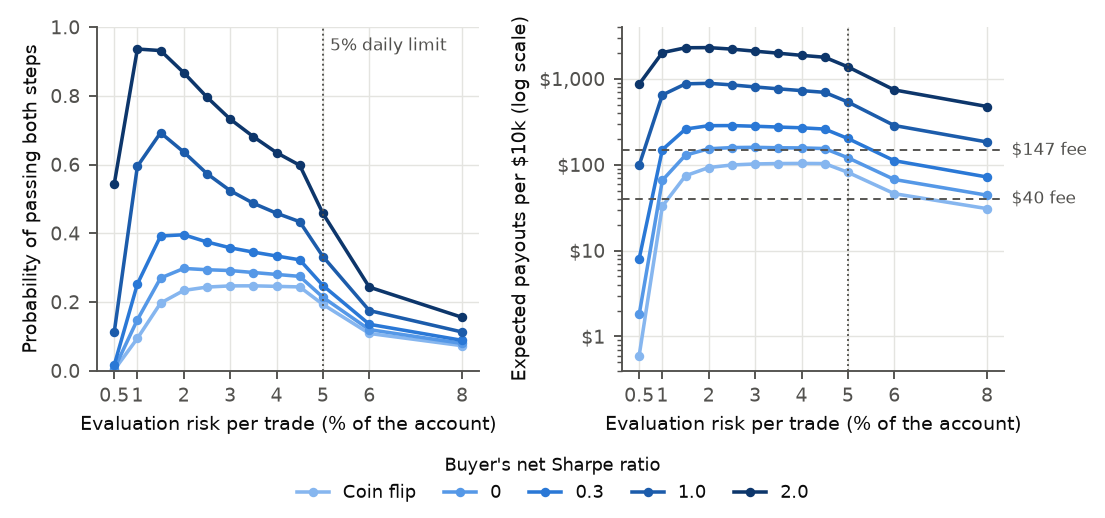
Expected payouts per purchase within 36 months, in dollars per $10,000 account (V), for a simulated buyer who takes one index trade a day. The buyer chooses a risk per trade in the evaluation (horizontal) and an intended risk once funded. Skill is the buyer's net Sharpe ratio: the coin flip has no skill and loses costs. Choose the skill levels, regime and funded risk. Dashed lines are the $40 promotional and $147 list fee of the base contract.
Select a point for detail. Rings mark the best fixed sizing the paper selected.
Two things to notice. Value is flat from about 3% to 4.5% risk per trade for the coin flip, then collapses at 5%, where one stop-out breaches the 5% daily limit. And small sizes are costly: conventional 1% risk leaves the no-skill buyer with $33 of value because the evaluation takes so long.
Sizing, skill and how long the buyer stays
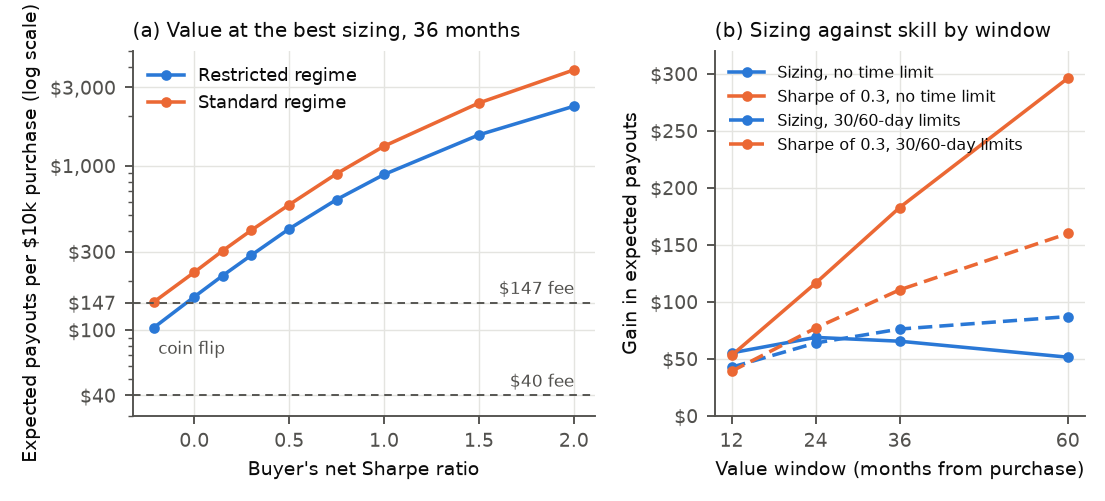
An earlier paper argued that risk sizing matters at least as much as skill. The registered hypothesis here was that sizing is worth more than a Sharpe ratio of 0.3. It was refuted, and a second registered run shows why: over a 12-month window the two are level, and from two years on skill leads, with or without the classic 30 and 60-day limits.
Dollars per $10,000 purchase, restricted regime. D is the sizing gain minus the skill gain; negative means skill is worth more. 95% intervals.
Real strategies through the contract
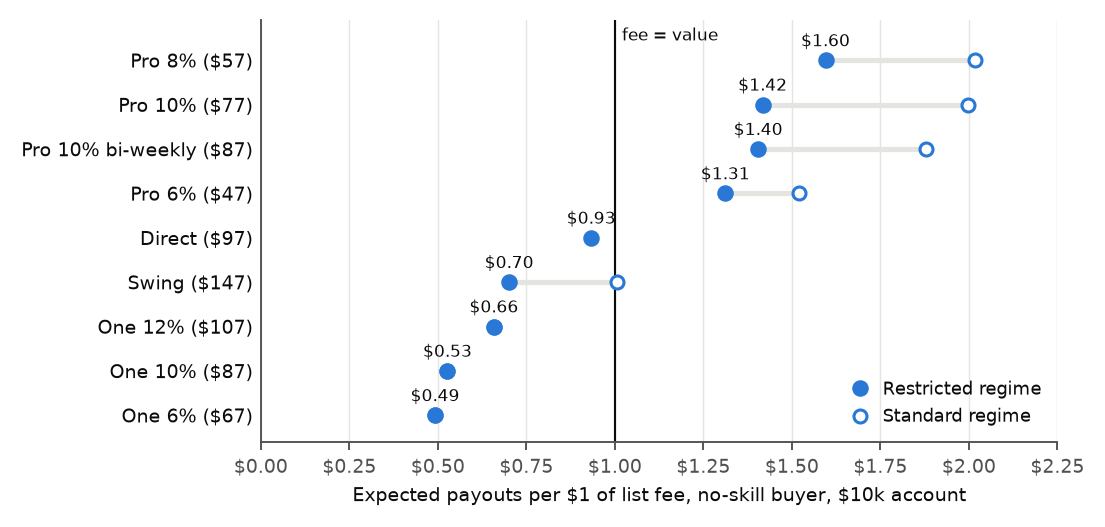
The skilled buyer above is idealised. The paper also runs the strategies that survived the author's earlier programme of 24 pre-registered tests (none a confirmed edge; two chosen after their parent tests were seen) through the contract as they actually trade. Every real book is worth less than an idealised buyer with the same Sharpe ratio. Early purchases are 2005 to 2014, late purchases 2017 to 2021.
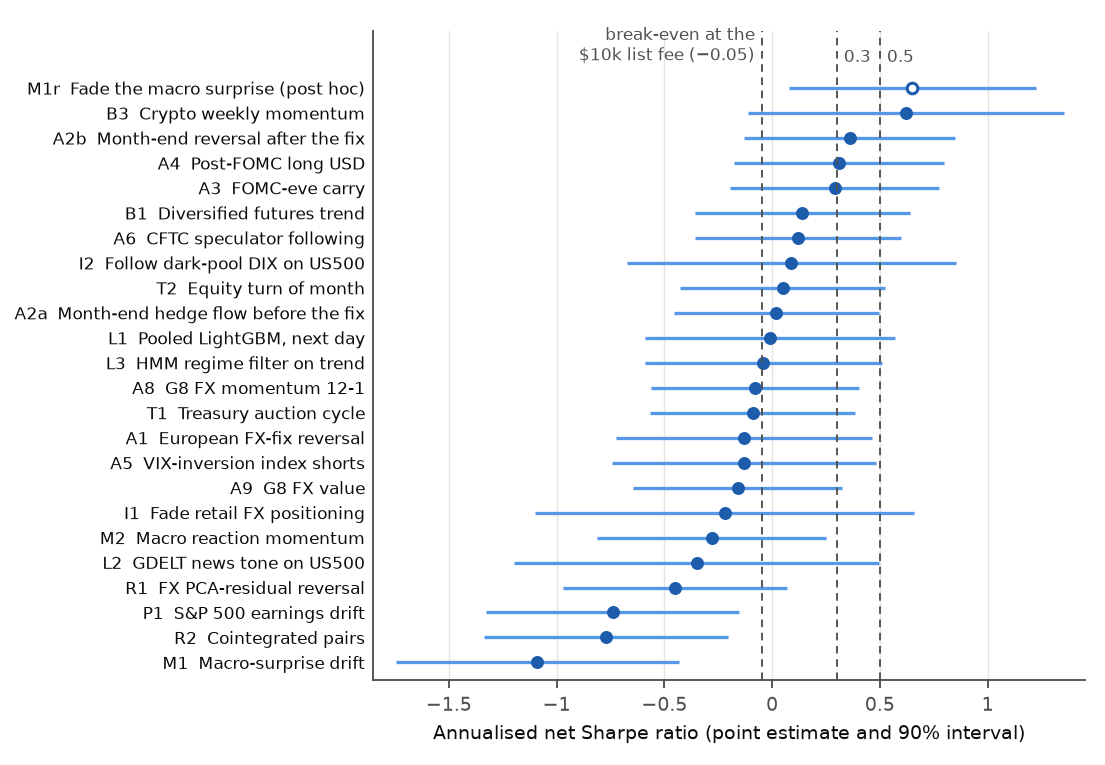
The 21 pre-registered hypotheses
Each hypothesis was fixed in a dated plan before its run, and is reported as found, including the ones the author expected to be true and were not.
Figures from the paper
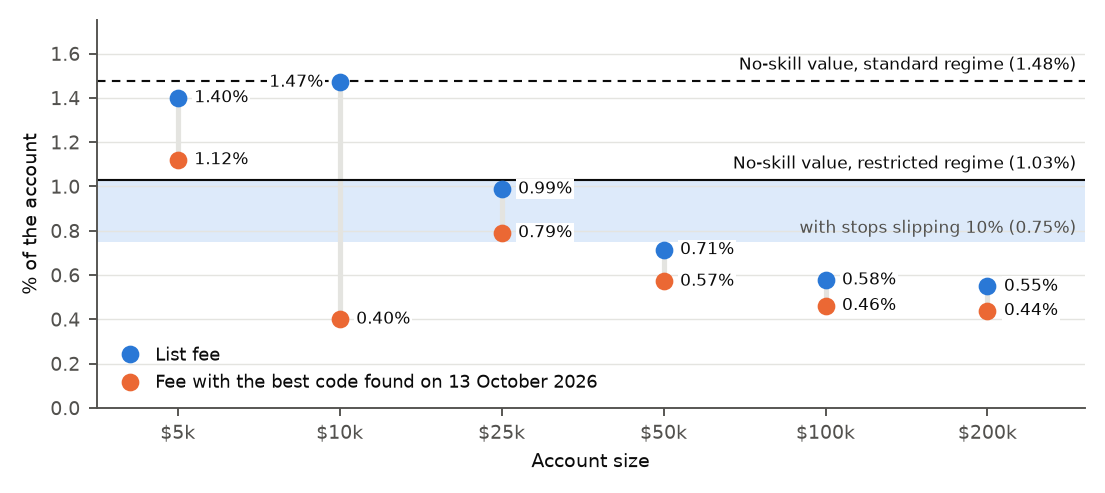
The paper's own exhibits, unedited. The full text, with every table and the source list for the contract's rules, is in the working paper PDF.
What this does and does not show
- Assumes the firm pays every valid request. Three published clauses are discretionary (a gambling policy, a requirement to maintain the same level of risk, and a review of each passed evaluation). They are not modelled, and the paper argues they are where much of the seller's margin sits.
- One firm, one index book, one broker's costs. The base case is a one-trade-a-day US500 book with costs measured on the broker's server. Other instruments give different values: $131 on NAS100, $95 on EUR/USD, $58 on USD/JPY for the no-skill buyer.
- Stops never slip in the simulation. An exploratory stress, not pre-registered, lowers the no-skill value to $88, $75 and $49 at 5%, 10% and 25% slippage.
- The skill is idealised, and the evidence that it exists is thin. "No edge found" is supported by the author's tests; "no edge exists" is not. Telling a Sharpe ratio of 0.3 from zero takes about 69 years of daily data.
- The rules were read on 13 October 2026 and may have changed. A draft working paper, not peer reviewed. Not investment advice.
- Not on this page: the raw price bars (not redistributed), the firm's web pages, and the private builders of the real strategies. Their daily series are in the reproduction package.